







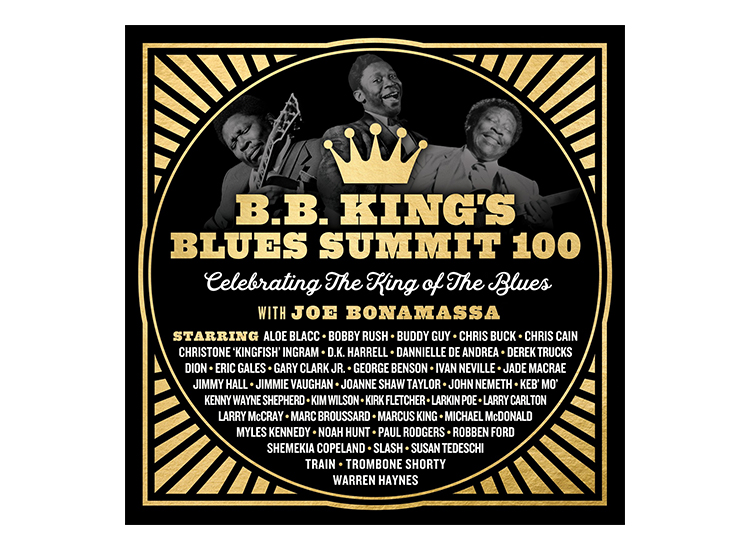
One of the most striking aspects of this 32-track project is the sheer scale and prestige of its guest list. It is not simply impressive, it is generational, panoramic, and historically meaningful. The album brings together world-class artists from different eras of blues, rock, soul, and rhythm & blues, creating a musical bridge between past, present, and future.
At the foundation, you have direct blues royalty. Buddy Guy stands as one of the last living giants of Chicago blues and a contemporary (and lifelong friend) of B.B. King himself. His presence alone anchors the project in authentic lineage.
Similarly, Jimmie Vaughan represents Texas blues tradition, a scene deeply intertwined with King’s touring history. Bobby Rush brings the Southern the soul-blues that connects directly to the roots from which King emerged.
Then there are artists who not only admired B.B. King but actively carried his influence into broader popular music. Eric Clapton, who collaborated with King on the album Riding with the King, is perhaps the most visible example of King’s transatlantic impact. His inclusion reinforces the historical continuity. Chaka Khan reminds us how deeply intertwined blues, soul, R&B and funk are.
The album also highlights the powerful middle generation of blues-rock torchbearers. Derek Trucks and Susan Tedeschi bring a refined, roots-conscious musicianship that echoes King’s emotional phrasing. Kenny Wayne Shepherd, Warren Haynes, Robben Ford, and Larry Carlton each represent different branches of blues-influenced guitar artistry with fusion, Southern rock, modern blues revival all indebted in some way to the King of blues.
Equally important is the younger generation. Christone Kingfish Ingram and Marcus King symbolize the future of the blues. Their participation transforms the album from a retrospective tribute into a living continuum. Likewise, Gary Clark Jr. bridges blues with contemporary rock and R&B sensibilities, proving the genre’s ongoing impact and evolution.
The project demonstrates the vast reach of B.B. King’s influence, with Paul Rodgers, Slash, and George Benson each carrying blues DNA into rock and jazz-fusion contexts. Their presence underscores how King’s phrasing and expression shaped far more than traditional blues.
What makes this guest list truly remarkable is not just its prestige, but its symbolism. It spans those who walked alongside B.B. King, established masters who grew up under his influence, and younger artists who inherited a language he helped define, and his influence remains active, vibrant, and very much alive.
From the very first track, Paying The Cost To Be The Boss’ (feat. Christone Kingfish Ingram), the album makes its intentions clear. It opens with a direct blues declaration, with warm and heartfelt vocals and immediately drawing the listener into a sound world that unmistakably honours B.B. King. What becomes evident right away is the true nature of this tribute: this is not an exercise in reproducing a sound, a mood, or a tone. It is a genuine artistic homage in which Joe Bonamassa and his guests masterfully restore the essence of the great B.B. King, making his legacy feel personal, relevant, and profoundly contemporary.
The following Don’t Answer The Door (feat. Marcus King) deepens this impression. The vocals delivers an intensely emotional slow blues ballad in a classic 12/8 feel. The interpretation vibrates with feeling, and the guitar serves as the perfect punctuation, never overwhelming, always responding. The beautifully shaped guitar solo pushes the track firmly into contemporary territory, bridging tradition and modern expression.
To Know You Is To Love You (feat. Michael McDonald, Susan Tedeschi & Derek Trucks) expands the sonic palette further. The beautiful vocal interplay once again confirms the exceptional calibre of the featured artists throughout the album. The song opens with electric piano weaving through subtle orchestral textures and guitar, while the guitar tone departs from the Gibson ES-335 sound so strongly associated with B.B. King’s beloved “Lucille.” This subtle tonal shift reinforces the album’s deeper intention: it is not confined to reproducing the past, but instead translates B.B. King’s influence into new artistic individuality.
By track four, Let The Good Time Roll (feat. Kenny Wayne Shepherd & Noah Hunt) the mood turns celebratory. The invitation to “let the good times roll” is infectious and irresistible. The dialogue between vocals and guitar creates a genuine party atmosphere, impossible to resist. That live energy becomes a defining characteristic of the entire record. The production is remarkably clear and beautifully polished, yet it constantly feels like a band playing together in a room, or even on a stage in front of an audience. There is a strong sense of musicians listening and responding to one another in real time. One almost wonders whether live sessions were used instead of heavy multitracking, in the recording and production process of the album, because the bonding feels authentic and immediate.
In Sweet Little Angel, featuring Buddy Guy, history doesn’t just echo, it speaks! This is perhaps the moment where the album comes closest to the purest essence of B.B. King himself.
When It All Comes Down (I’ll Still Be Around), featuring Larry McCray, lifts the energy with a spiritual, almost gospel choral undertone, while When Love Comes To Town (feat. Slash, Shemekia Copeland & Myles Kennedy) delivers the album’s heaviest blues-rock moment: a thick, gritty, and thrilling distorted, overdriven guitar and powerful chords, in a powerful fusion of blues and rock.
The Thrill Is Gone (feat. Chaka Khan & Eric Clapton) once again confirms the outstanding calibre of the guest artists, here nothing less than double royalty.
The arrangement broadens beautifully, allowing the strings to take on a more melodic and interactive role. What emerges is a wonderful dialogue between voice and guitar, a true musical conversation.
Why I Sing The Blues (feat. Bobby Rush) stands out for its length, 6m44s, and for the unusual prominence of the bass. Opening with the bass and allowing it to remain central creates a deep groove-driven atmosphere. It highlights the vast expressive sonic canvas of blues and rhythm & blues, showing how many shades and rhythmic possibilities exist within the tradition.
Don’t You Want A Man Like Me (feat. Larkin Poe) bursts with big band swing energy in its final crescendo, only to be followed by I’ll Survive (feat. Keb’ Mo’)’s return to melancholic 6/8 slow blues, a broken-heart survival tale that reminds us how deeply the blues lives in vulnerability.
Heartbreaker (feat. Trombone Shorty & Eric Gales) introduces brass, trumpet and trombone, engaging in lively call-and-response with the vocals, and There Must Be A Better World Somewhere (feat. George Benson) brings in saxophone joining the conversation with voice, guitar, and piano, all beautifully framed by Hammond textures. Every instrument finds its place. Nothing is overcrowded. Every nuance of phrasing can be appreciated, and the guitar work is absolutely exquisite.
Chains and Things (feat. Gary Clark Jr.), opens with a Rhodes electric piano in a nocturnal, suspended atmosphere. The imagery of “chains” resonates on multiple levels: personal burdens, liberation, and the tragic historical roots of blues itself. The guitar solo here is deeply emotional, restrained yet powerful.
Ghetto Woman (feat. Ivan Neville) creates an intimate soundscape with electric piano and Hammond organ, allowing a warm, soulful blues voice to unfold. The guitar acts as a vocal counterpart, responding as if it were another singer, while the piano complements the dialogue with subtle harmonic depth.
Night Life (feat. Paul Rodgers), begins with the guitar alone, a weeping voice from the very first note. When the human voice enters, it feels as though it is simply giving words to what the guitar has already confessed.
Never Make a Move Too Soon (feat. Dion) makes the album’s live feeling explicit by opening with ambient club sounds: glasses, movement, atmosphere. It reinforces the illusion of stepping into a living performance, with palpable joy and bonding among the musicians. And the following Three O’Clock Blues (feat. Marc Broussard & Josh Smith), feels like the after-hours moment: the club empty, the band playing one last intimate jam at three in the morning. Reflective, suspended, nocturnal.
So Excited (feat. Aloe Blacc) borders on funk, driven by infectious groove and rhythmic tightness. Again, the album shows not only the stylistic fluidity of the blues, but also its fundamental role in shaping modern music genres.
By track thirty-one, Playin’ With My Friends, the closing guitar solo feels like an encore, like the final statement at the end of a great concert. It leaves a lasting impression of mastery.
The album closes with a final, inspired gesture:track thirty-two, Better Not Look Down (feat. Kirk Fletcher) is a spoken-word tribute in which the participating artists offer personal testimonies, transforming the ending into a collective act of gratitude. It makes unmistakably clear how essential B.B. King has been to the evolution of blues, rhythm and blues, and modern music as a whole.
In conclusion, a master like Joe Bonamassa pays homage to another master, B.B. King, a legend who inspired him, through a star-packed album that reflects King’s legacy across time and generations. It is not merely a tribute, but a living testament to an influence that continues to resonate.
Released just one year after what would have been the 100th birthday of B.B. King, this album feels both commemorative and forward-looking, celebrating a century of legacy while opening the door to a hundred more years of his enduring voice, relevance and inspiration.
Review by: Stefano Barone